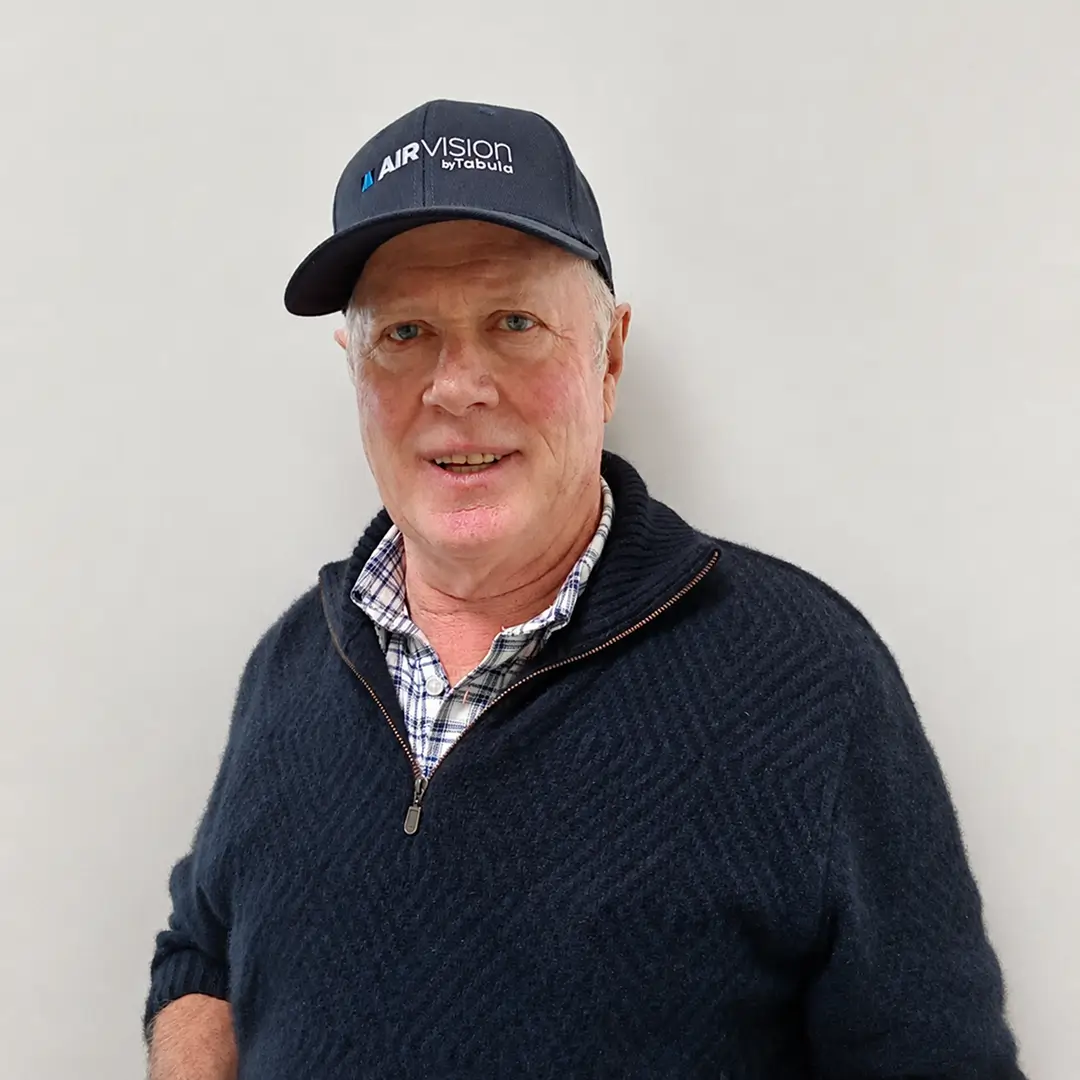
Twenty Years at Tabula: Gerald Harrex
Meet the man who’s spent twenty years helping take Tabula from trucks to aircraft.
Gerald Harrex wasn’t looking for a job in technology when he bumped into an old schoolmate on the street in 2006.
That old schoolmate was Tabula founder Colin Brown.
“I knew Colin from school. I knew he was clever. We just bumped into each other in the street years later, and he showed me his GPS guidance system. We drove around the block in his car and he showed me how it worked. That’s how it started.”
At the time, Colin was developing a GPS guidance and proof-of-application system for New Zealand agriculture. Gerald’s background in agriculture, machinery and electronics meant he could see the potential almost immediately.
“Colin was the brains and I came along for the journey,” Gerald says. “I cottoned on to the opportunity. Fertiliser trucks working on rolling country having guidance and help to spread more accurately was a new angle.”
Gerald could install the technology. More importantly, he understood the people who would be using it.
And so began a relationship with Tabula that’s now lasted twenty years.
Learning on the road
There wasn’t exactly an established playbook for selling and installing GPS technology into fertiliser trucks in 2006.

It was incredibly exciting to fit our first unit in October 2006. But the truth is, we didn’t know how it was going to go. It was complex and there were certainly teething problems and glitches.
The team was learning almost as quickly as customers were.
“We didn’t quite understand how the operators would be using them and what they needed exactly from the software. We didn’t know what buttons the operators would press and in what order — even by mistake.”
Installations could take half a day or longer. Days regularly stretched late into the night, with weekends spent travelling between customers.
And when something didn’t work, there wasn’t a remote software update waiting back at the office.
“We would go to an installation, install the system and, if there was a problem, we might already be on our way to the next customer. A team member would be in the back seat of the truck editing code while we were travelling, then we’d return to the previous customer to fix it. We were literally writing code as we moved.”
After the first half-dozen installations, Gerald remembers things beginning to settle down.
Then customers started seeing what the technology could do.
From a ‘maybe’ to a necessity
One of the challenges in those early days was explaining why somebody needed technology they’d never used before.
“No one knows what they don’t know,” Gerald says. “Initially, we had to explain the product in order to sell it.”
The demonstrations helped change that.
We could literally show them where they overlapped or missed spreading, and they realised they needed to be more competitive.
Digital mapping brought another shift. A paddock somebody thought was 20 hectares might actually be 24. Knowing the real area meant more accurate rates, better planning and a clearer understanding of the work being completed.
“It went from being a maybe to being a business necessity in a few months.”
The technology itself was changing quickly too.
“Once we moved to touchscreen in-cab units, and much improved back-office online capability, that was a game changer. Before that, we had to mount these huge units and it could take hours to install all the different components.”
And the opportunity was getting bigger.
Then came the aircraft
TracMap had initially concentrated on agricultural contractors, but it wasn’t long before the team realised farmers operating their own machinery could benefit too.
“That’s when it started ramping up,” Gerald remembers. “That’s when we realised we needed regional salespeople.”
Then another opportunity appeared.
A competitor stepped away from a space in agricultural aviation, leaving an open door. Gerald, with his combination of agricultural, machinery and technical experience, began selling aviation systems too.
It would become another major part of his time with Tabula.
“We were just thinking about fertiliser… but the markets we’ve moved into are a whole new cause for excitement.”
Agricultural aviation would eventually be followed by horticulture, viticulture and other complex field operations.
Yet Gerald believes the principle underneath it all has remained remarkably consistent.
“Something that’s always stayed the same is our core business. Our principle of being able to prove what work was done and where, and delivering that value, is still at our core. That’s how we moved into new markets — from ground spreading to agricultural aviation, and onwards into horticulture and viticulture.”
Beyond the cab and cockpit
Ask Gerald what best demonstrates how far Tabula has come, and he doesn’t point to a piece of hardware.
Guidance is guidance, but it’s what we do beyond the cab and cockpit that makes Tabula amazing to me. Tabula Live is the standout element. We connect so much more now.
For someone who remembers installations taking hours and software being rewritten in the back of a moving vehicle, today’s ability to connect information across an operation represents a considerable change.
Gerald hears that from customers too.
“Operators are now saying to me they can’t operate without it. Fewer mistakes, live visibility, their customers getting the proof they need. It’s what we provide around the wider operation.”
Still along for the ride
Twenty years is a long time to spend with one company.
Gerald has technically tried retiring.
More than once.
“I’ve retired a couple of times already, but came back,” he laughs. “I like what we’re doing. We’re making a real difference. It’s exciting.”
Perhaps that’s fitting for someone who joined after an unexpected encounter on the street and a drive around the block in Colin’s car.
Back then, Gerald could see an opportunity in helping fertiliser operators spread more accurately. Neither of them knew exactly where that opportunity would lead to.
“We had no idea what we were capable of, but once we were moving, I saw the opportunities were endless.”
Twenty years later, Gerald has watched the technology move from fertiliser trucks into tractors, orchards and aircraft. He’s watched physical maps become digital, hardware become connected and a small New Zealand business become Tabula — a global player.
And despite a couple of attempts at retirement, he’s still here to see what happens next.
“It’s been an exciting journey. And there’s still so much ahead of us.”
Next Up: Read about how TracMap became Tabula as the solutions grew to connect whole operations.